




Top Handle Bags vs Shoulder Bags: Which Style Fits Your Lifestyle?
A fashion buyer once told me she can read a woman’s entire daily routine by which bag style she reaches for — the top handle carrier manages meetings and lunches with composed precision, while the shoulder bag carrier juggles groceries, children, and a phone call simultaneously without breaking stride. Neither is wrong; they simply optimize for different realities. Top handle bags deliver structured elegance that elevates any outfit through intentional, polished carry. Luxury shoulder bags deliver effortless practicality that keeps both hands free for the unpredictable demands of real life. The style that fits your lifestyle depends on how you spend your actual hours — not how you imagine your ideal day looking on social media. This guide compares both styles across every dimension that matters for daily use: comfort, capacity, occasion range, outfit versatility, and the subtle social signals each silhouette communicates.
What Is the Fundamental Difference Between Top Handle and Shoulder Bags?
The fundamental difference is carry position and what it enables — top handle bags are carried in-hand or at the elbow, requiring one hand dedicated to the bag at all times, while shoulder bags rest on the shoulder or across the body, leaving both hands completely free for other tasks.
Side-by-side comparison:
| Feature | Top Handle Bag | Shoulder Bag |
|---|---|---|
| Carry position | In hand, crook of elbow | On shoulder, across body |
| Hands free | One hand occupied (or both free if set down) | Both hands free at all times |
| Silhouette effect | Elongates arm line, formal posture | Relaxes body line, casual ease |
| Formality level | High (professional, elegant) | Medium (polished casual to smart) |
| Comfort on long carries | Lower (hand/arm fatigue after 30+ minutes) | Higher (weight distributed to shoulder/torso) |
| Access speed | Requires setting down or switching hands | Can access while bag remains on shoulder |
| Best environments | Meetings, restaurants, events, curated outings | Commuting, errands, travel, active days |
| Typical structure | Rigid/semi-rigid (maintains shape) | Soft to semi-structured (conforms to body) |
The choice is ultimately about what you need your bag to do: look composed at every moment (top handle), or facilitate movement and multitasking without thought (shoulder). Most women benefit from owning both for different contexts.
Which Style Works Better for Professional Settings?
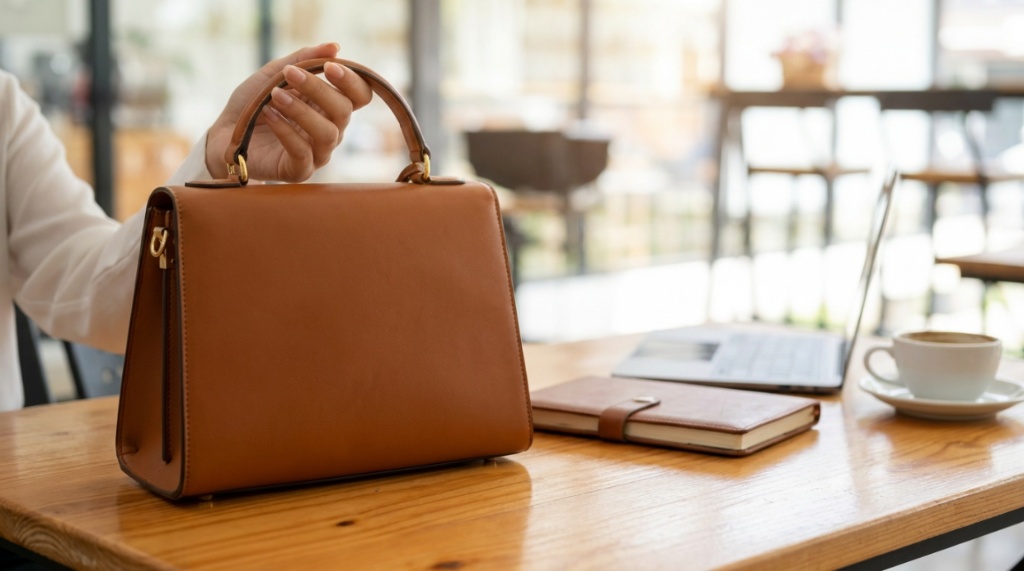
Top handle bags project more authority and intentionality in professional settings because the structured silhouette and deliberate carry position communicate control, preparation, and attention to presentation — qualities that align with professional confidence signals.
Why top handles dominate professional contexts:
- Visual authority: The structured shape reads as “organized” — a visual shorthand for competence. Soft shoulder bags can read casual even when expensive.
- Posture effect: Carrying in-hand or at elbow naturally straightens posture, squares shoulders, and creates a confident physical presence.
- Setting behavior: A top handle bag sits neatly beside a chair, on a conference table, or at your feet without slumping. Shoulder bags deflate when set down.
- Outfit elevation: The defined silhouette adds a “finishing piece” quality to professional outfits that casual carry styles cannot replicate.
When shoulder bags work professionally:
- Creative industries where personal style matters more than formality
- Commute-heavy workdays where hands-free practicality outweighs arrival aesthetics
- Casual professional environments (tech, startups, academia)
- Days requiring heavy carrying (laptop, documents, multiple items)
Which Style Is More Comfortable for All-Day Use?
Shoulder bags win comfort for all-day use because they distribute weight across the shoulder and torso rather than concentrating it on the hand and forearm — preventing the grip fatigue, wrist strain, and arm soreness that top handle bags cause during extended carry periods.
Comfort factors:
- Weight distribution: Shoulder carry distributes bag weight (typically 2–4 lbs full) across a wide shoulder strap area. Hand carry concentrates the same weight on a narrow handle pressing into palm skin and finger joints.
- Duration tolerance: Most women carry a shoulder bag comfortably for 4–8 hours. Most experience hand fatigue from top handle carry within 30–60 minutes of continuous holding.
- Asymmetric loading: Both styles create asymmetric weight distribution, but shoulder bags allow easy side-switching. Top handle bags rarely switch hands naturally.
- Activity compatibility: Shoulder bags allow walking, shopping, phone use, carrying children, and gesturing freely. Top handle bags restrict one hand from all activities.
The comfort gap narrows significantly with convertible top handle bags that include detachable shoulder straps — providing the structured aesthetic for formal moments with strap-on practicality for active periods. This hybrid approach represents the best of both styles for women who transition between contexts throughout a single day.
Finding the right daily companion depends entirely on your environment. If your day involves packed subways and rushing between meetings, you need something that blends fashion with ultimate functionality. Are you searching for the ultimate Commuter Bag for New York Professionals? Choosing between the structure of a top handle and the hands-free ease of a shoulder strap can completely change how you navigate your busy city routine.
Which Style Offers More Outfit Versatility?
Top handle bags offer slightly more outfit versatility because their structured formality works upward (elegant events) and can be dressed down (casual with jeans), while shoulder bags work downward easily but sometimes struggle to achieve true formality regardless of their material quality or brand prestige.
Versatility range by style:
- Top handle bag range: Black tie events → professional meetings → smart casual → elevated casual. Struggles only with athletic/activewear contexts where the formality feels mismatched.
- Shoulder bag range: Smart casual → everyday casual → errands → travel → commuting. Struggles to feel formal enough for galas, important meetings, or events where polished presentation matters.
The top handle’s versatility advantage comes from a fashion principle: it is easier to dress down a formal item (structured bag + jeans = intentionally chic) than to dress up a casual item (shoulder bag + evening wear = trying too hard).
However, this versatility is theoretical — it only matters if your actual life includes formal contexts. A woman whose days involve school runs, grocery shopping, and home-office work benefits more from shoulder bag practicality regardless of its narrower formal range.

Can You Own Just One Style, or Do You Need Both?
Most women need both styles to cover their full lifestyle without compromise — but if forced to choose one, a medium top handle bag with a detachable crossbody strap provides the widest single-bag coverage by offering structured elegance for formal moments and hands-free practicality for active ones.
Decision framework:
- Choose top handle only if: Your days are primarily professional/social, you rarely carry heavy loads, you value aesthetic impact over ergonomic convenience, and you are comfortable dedicating one hand to your bag.
- Choose shoulder bag only if: Your days are primarily active/errand-heavy, you need both hands free constantly, comfort outweighs formality in your priorities, and you rarely attend formal events.
- Choose convertible (best single option) if: Your days vary between formal and casual, you want flexibility without owning multiple bags, and you value the option to switch carry styles based on the moment.
- Own both if: Your lifestyle includes distinct formal and casual contexts, you appreciate each style’s strengths without compromise, and your budget supports two quality pieces rather than one.
For detailed comparisons of top handle and shoulder bag styles evaluated for real-world versatility across different lifestyles, top handle bags reviewed for California lifestyles provides assessments of how each style performs across the diverse contexts that modern women navigate daily — from boardrooms to beach towns.
Conclusion
Top handle bags deliver structured elegance, professional authority, and outfit-elevating formality at the cost of one occupied hand and reduced comfort during extended carry. Shoulder bags deliver hands-free practicality, all-day comfort, and effortless ease at the cost of reduced formal presence and less defined aesthetic impact. Neither is universally better — each optimizes for different lifestyle priorities.
The most satisfied bag owners match their primary style to their primary reality — not their aspirational lifestyle. If 80% of your hours benefit from hands-free convenience, a shoulder bag is your workhorse regardless of how elegant top handles look in magazine spreads. If your days revolve around meetings, events, and curated outings, a top handle matches your actual needs. Own both if your life genuinely spans both contexts. And if budget allows only one, the convertible top handle with detachable strap covers the widest range with a single investment.
Which style dominates your daily carry — and would you switch if you could? Share your experience below.
Frequently Asked Questions
Are top handle bags impractical for mothers?
Traditional top handle bags are challenging for mothers of young children because both hands are frequently needed. However, convertible top handles with crossbody straps solve this entirely — providing structured elegance during child-free moments and hands-free security during parenting mode. Many mothers use top handles for date nights and professional events while defaulting to shoulder/crossbody for school runs and playground visits.
Do shoulder bags cause back or shoulder pain?
Heavy shoulder bags carried consistently on one side can cause muscle imbalance, shoulder tension, and upper back pain over time. Prevent this by: alternating sides regularly, keeping bag weight under 3 lbs total, using wider straps that distribute pressure, and choosing crossbody carry (distributes weight across torso) over single-shoulder carry for heavy loads.
Which style holds value better for resale?
Top handle bags from heritage brands (Hermès Kelly, Lady Dior, Fendi Peekaboo) retain value better because the structured format has proven timeless for 60+ years. Shoulder bags fluctuate more with trend cycles — some become icons (Chanel Classic Flap) while others fade quickly. For investment purposes, structured top handles have the stronger track record of value retention.
Can a top handle bag work for travel?
Top handle bags work for curated travel (city trips, business travel, resort destinations) where hands-free is not constantly required. They struggle with active travel (hiking, adventure, backpacking) or situations requiring constant movement through crowds. For travel versatility, a convertible top handle with crossbody strap provides the ideal balance between style and practicality.
What size shoulder bag is most versatile?
A medium shoulder bag (10–12 inches wide, 7–9 inches tall) with a structured bottom provides the most versatile shoulder carry option. Large enough for daily essentials plus a small extra (book, water bottle) but compact enough to maintain elegance rather than becoming a catch-all tote. Avoid oversized shoulder bags for versatility — they read purely casual regardless of material quality.
Is the crossbody style replacing both top handles and shoulder bags?
Crossbody bags have grown in popularity but cannot fully replace either category. They lack the formal authority of top handle carry and the capacity of larger shoulder bags. Crossbody works best as a casual/travel option or as the convertible function of a top handle bag — not as a standalone replacement for structured elegance or substantial daily carrying capacity.
Which style photographs better for social media?
Top handle bags photograph more distinctively because their structured shape creates a defined silhouette in images. Shoulder bags can appear shapeless in photos, especially when worn across the body. For style documentation or content creation, top handles provide cleaner visual impact. For actual living (which happens between photos), choose based on function rather than visual performance.
